
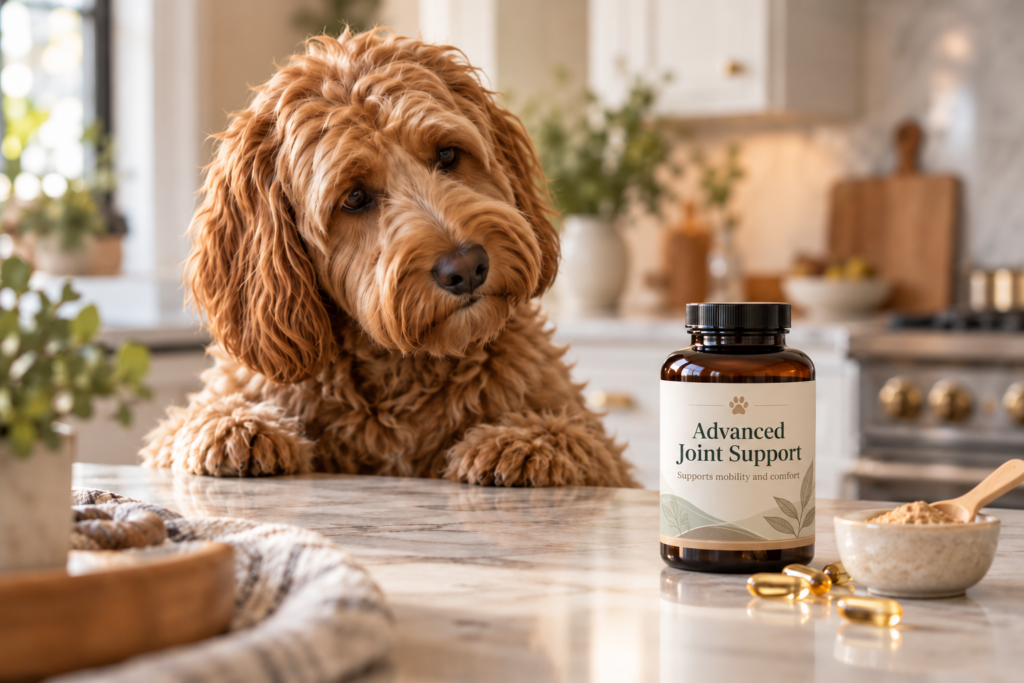
How a bottle outsmarted me
I have spent years reading dog-food labels, questioning health claims and telling families not to be dazzled by the word natural. You might reasonably assume I would be difficult to fool.
Apparently not.
Give me a handsome label, a green-lipped mussel and the suggestion that I am doing something splendid for my dog and I will fetch my wallet myself.
It began, as many expensive ideas do, with me standing at the kitchen counter trying to improve a dog who had not asked to be improved.
Ripple is nine and has osteoarthritis in one shoulder. Most days she is active, happy and perfectly capable of a three-kilometre hike. Then she overdoes the running, the limp returns and I begin staring into the supplement cupboard as though it contains the answer to life.
For more than a year, I added Safe-Sea to Ripple’s meals. I believed I was giving her a useful marine joint oil with green-lipped mussel.
I thought I saw a small improvement. Perhaps I did. She was also resting more and sore shoulders are famously inconsiderate about improving on a scientifically convenient schedule. So no, I cannot honestly give the bottle the credit.
Still, I kept buying it. The bottle looked confident, Ripple ate dinner without filing an objection and I wanted to be helpful. Between the three of us, we formed a very efficient purchasing arrangement.
Then I committed the deeply inconvenient act of ignoring the front label and doing the maths on the back.
At the serving for a dog Ripple’s size, Safe-Sea provides roughly:
Twenty-two milligrams of mussel oil. Apparently the mussel only needed to attend the meeting, not contribute.
To be fair, that does not make every ingredient in Safe-Sea useless. Ahiflower oil supplies plant fatty acids and astaxanthin is an antioxidant. But it was not providing the measured marine omega-3 dose I thought I was buying.
I have spent years telling other people to read labels and then a label took me out for dinner. There is no elegant way to report that, so I may as well be useful and report it honestly.
Safe-Sea is not alone.
Joint formulas adore a guest list: green-lipped mussel, turmeric, collagen, hyaluronic acid, Boswellia, glucosamine, tart cherry and perhaps a mushroom wandering through for atmosphere.
It is less a supplement than a charcuterie board. The label looks generous, sophisticated and faintly capable of arranging your mortgage.
Unfortunately, the number of ingredients is not the number of benefits.
An ingredient may be present at a decorative dose. It may have only preliminary evidence. It may borrow credibility from a completely different extract used at a completely different amount. The name gets invited onto the label; the evidence is left standing outside in the rain.
Now for the brief lab-coat interruption.
A 2022 systematic review examined 57 articles covering 72 osteoarthritis trials in dogs and cats. Omega-3-enriched diets and omega-3 supplements had the clearest nutraceutical benefit. Collagen evidence was weak and glucosamine-chondroitin combinations showed a marked lack of effect.
Science does have a terrible habit of ruining a lovely label.
Green-lipped mussel has some encouraging canine evidence, but the preparation and dose matter. A stabilised mussel powder studied at a particular dose cannot wave a tiny scientific wand over 22 mg of mussel oil and make the two equivalent.
That is marketing by association, which is rather like standing beside an Olympic athlete and expecting to become faster.
While Ripple was helping expose my expensive optimism, Spirit was waiting at the other end of the kitchen.
She is ten, has heart disease and receives Carino seal oil. I have routinely recommended Carino to our families as a Canadian source of marine omega-3, so this was the moment when the investigation became slightly personal.
It is always more fun to question somebody else’s cupboard.
The good news is that Carino tells us useful numbers. One teaspoon contains:
That gives us 630 mg of combined EPA and DHA, plus DPA. The oil also contains alpha-tocopherol as an antioxidant.
I can calculate what I am giving, which should not feel revolutionary, yet here we are.
Short answer: no.
Longer answer: still no, unless there is a reason.
Carino is a transparent marine oil and a reasonable way to add measured EPA and DHA when extra omega-3 is appropriate. I would choose it over a crowded joint concoction that gives me impressive nouns but no useful marine dose.
That does not turn it into compulsory dinner garnish.
A healthy dog thriving on a complete and balanced diet is not a problem waiting for a supplement. I can find no good evidence that routinely adding Carino will prevent osteoarthritis, protect a normal heart or improve a life already going rather well.
In the COAST osteoarthritis guidance, healthy dogs without risk factors were not advised to have a special joint diet. Even among dogs with risk factors but no clinical signs, only one of nine experts supported an omega-3 supplement and there is no established preventive dose.
So my advice is changing.
Carino should not be an automatic extra for every healthy adult dog or puppy eating a properly balanced diet. More supplements are not merit badges and good products are not party favours. We do not have to hand one to everyone who arrives.
I had already stopped routinely adding Carino and Olie probiotic to our puppy food boxes because they were beginning to feel superfluous. That instinct was sound.
A probiotic can be useful when there is a reason for that probiotic. Marine omega-3 can be useful when there is a reason for marine omega-3.
The cupboard is not a retirement home for products that once seemed like a good idea.
There are very good reasons to use measured EPA and DHA.
A veterinarian may include them in a plan for confirmed osteoarthritis, certain inflammatory skin problems, high blood lipids or selected cardiac, kidney and other illnesses. The evidence, target dose and cautions differ for each condition.
Carino can be the marine source if its concentration, calories and freshness suit that particular dog.
The diagnosis comes first. The bottle does not get to nominate itself.
What I would no longer call treatment is a casual squirt.
The 2023 COAST osteoarthritis guidelines suggest starting at 75 to 100 mg/kg/day of combined EPA and DHA for a dog with clinical osteoarthritis.
A 25 lb dog would need roughly 850 to 1,135 mg a day. Carino supplies 630 mg per teaspoon, so that takes about 1⅓ to 1¾ teaspoons and adds roughly 55 to 73 calories.
“A squirt” may be a perfectly good unit for ketchup. It is not a therapeutic dose.
This is where oil becomes awkward.
Keeping a dog lean is one of the most effective things we can do for arthritic joints, yet one teaspoon of Carino carries about 40 to 45 calories. Those calories do not become invisible because they arrived looking medicinal.
A more concentrated veterinary omega-3 product may deliver the target EPA and DHA with less oil, or a therapeutic joint diet may already supply it. The right choice depends on the dog, not the bottle’s talent for adjectives.
Nor is extra oil harmless simply because it came from something that once swam.
Reported concerns include:
Some risks are dose-dependent or incompletely understood, but they are enough to retire “just in case” as a nutritional strategy.
Carino’s DPA is interesting, but the company’s claims that DPA is ten times more powerful than EPA and that mammalian oil is more easily absorbed by dogs go beyond the canine clinical evidence I could find.
For joint-dose decisions, I would still count the EPA and DHA. DPA is an addition, not permission to ignore the better-studied numbers.
There is one more uncomfortable truth about marine oil: what left the factory is not necessarily what reaches the bowl months later.
EPA and DHA are fragile fats. Oxygen, heat and light oxidise them. As that happens, intact fatty acids are lost and oxidation products take their place.
At some point the bottle becomes less “valuable joint support” and more expensive fish-scented optimism.
Salmon oil deserves particular caution because it often arrives in a large pump bottle and lives beside the dog food. Warm kitchen, a little light and two refreshing gulps of air every day.
We may as well book oxidation a spa weekend.
That does not make every salmon oil useless. A properly refined, protected, packaged and stored oil can meet quality standards. But “salmon” on the front tells us nothing about its condition after processing, shipping and weeks of pumping.
Seal oil is also marine oil. It does not receive diplomatic immunity.
1. How much EPA and DHA does it actually provide?
The label should state the milligrams in the dog’s daily serving, not merely the amount of total oil or total omega-3.
2. Is the finished product tested for oxidation?
Ask whether the company tests peroxide value, anisidine value and TOTOX by batch. A certificate for the raw oil before bottling is less reassuring than testing the finished product throughout its shelf life.
3. How is the oil protected?
Look for an opaque, well-sealed container, an antioxidant such as mixed tocopherols and a bottle size the household will finish promptly.
Capsules reduce repeated exposure of the entire supply to air. Each dose gets its own tiny bunker.
4. What are the storage directions?
Keep marine oil cool, dark and tightly closed. Refrigerating liquid oil after opening is a sensible precaution unless the manufacturer directs otherwise.
Do not keep a large pump bottle warm for months simply because the best-before date has not arrived.
Carino says to keep its oil away from direct sunlight and use it within six months of opening, or refrigerate it after opening. I would choose the refrigerator immediately and buy a size I can finish promptly.
An antioxidant slows oxidation. It is not a tiny security guard standing inside the bottle with a clipboard.
Here are the labels after I removed the soft lighting and background music.
The servings below are based on a 25 lb dog. Canadian retail costs were checked in September 2026 and will change.
| Product | What the dog gets | My plain-English take |
|---|---|---|
| North Hound Life Hip & Joint Health | 1,500 mg green-lipped mussel powder. Approximately $16 per month. | Simple and fully disclosed. A reasonable green-lipped mussel option, although the product does not quantify its fatty acids. |
| North Hound Life Elite+ | 20 mg UC-II, 820 mg hydrolysed collagen, 120 mg Boswellia, 10 mg hyaluronic acid and 30 mg vitamin C. Approximately $54 per month. | Transparent, but it does not provide the same dose or combination used in the small recent UC-II and Boswellia trial. Expensive for evidence that remains preliminary. |
| Four Leaf Rover Hip & Joint | 860 mg green-lipped mussel, 300 mg eggshell membrane, 150 mg poria and 75 mg curcumin. Approximately $21 per month. | A very attractive ingredient party. Most of the useful support rests on green-lipped mussel. Evidence for the other guests is limited or specific to particular formulations. |
| Four Leaf Rover Safe-Sea | Approximately 958 mg Ahiflower oil, 56 mg GLA, 22 mg green-lipped mussel oil and 0.5 mg astaxanthin. Approximately $22 per month. | Primarily a plant oil. It discloses no EPA or DHA and provides very little mussel oil. It was not doing the marine joint job I thought I had bought it to do. |
| PURICA Pet Recovery | At the full serving: 1,000 mg glucosamine HCl, 1,000 mg MSM, 500 mg lysine, 410 mg magnesium ascorbate, 160 mg Boswellia and 34 mg hyaluronic acid. Approximately $25 to $28 per month. | The amounts are clear, but the formula leans heavily on glucosamine and MSM. Inulin and other inactive ingredients may matter to a dog with a sensitive stomach. |
| Thrive Joint Support Fusion | MSM, glucosamine HCl and chondroitin in undisclosed amounts. The cost cannot be judged accurately without knowing those amounts. | A proprietary blend asks me to pay first and learn nothing. This is the easiest no on the table. |
| WellyTails Advanced Hip & Joint | Glucosamine, chondroitin, MSM, green-lipped mussel, hyaluronic acid, combined ALA/EPA/DHA and numerous additional ingredients. Approximately $30 per month at the maintenance serving. | Detailed but crowded. Combining plant-derived ALA with EPA and DHA hides the actual marine dose. So many components also make reactions and results difficult to interpret. |
From now on, I will not begin with a joint product. I will begin with the dog, which feels obvious now that I have written it down.
A recurring limp needs a diagnosis. Confirmed osteoarthritis needs a lean body, sensible regular movement, rehabilitation when useful and proper pain relief.
A supplement may support that plan. It cannot swagger in and replace it.
If extra omega-3 is appropriate, I will look for a fresh, tested marine product that states exactly how much EPA and DHA it provides.
Carino can meet that description. Its calorie load may make a more concentrated product preferable when a therapeutic joint dose is needed. I may consider a straightforward green-lipped mussel product as a secondary option.
I will be considerably less dazzled by twelve lovely ingredients packed into one scoop like a clown car.
Then I will change one thing at a time and decide in advance what improvement should look like:
Memory is a dreadful research assistant.
If nothing measurable changes after a fair six-to-eight-week trial, the supplement has not earned permanent cupboard residency.
Safe-Sea earned its place in my cupboard because I believed the story on the label. It lost that place when I finally counted what reached Ripple’s bowl.
I do not especially enjoy admitting that I spent more than a year funding a bottle’s self-esteem, but it may be the most useful thing in this article. If a label can fool me, it is probably having a very productive afternoon elsewhere.
This article is educational and is not a diagnosis or treatment plan. Evidence and product labels were reviewed in September 2026.
You will receive an email asking you to confirm your subscription. Be sure to check your spam folder. If you haven’t received a confirmation email after 24 hrs. please reach out via our Contact form.