
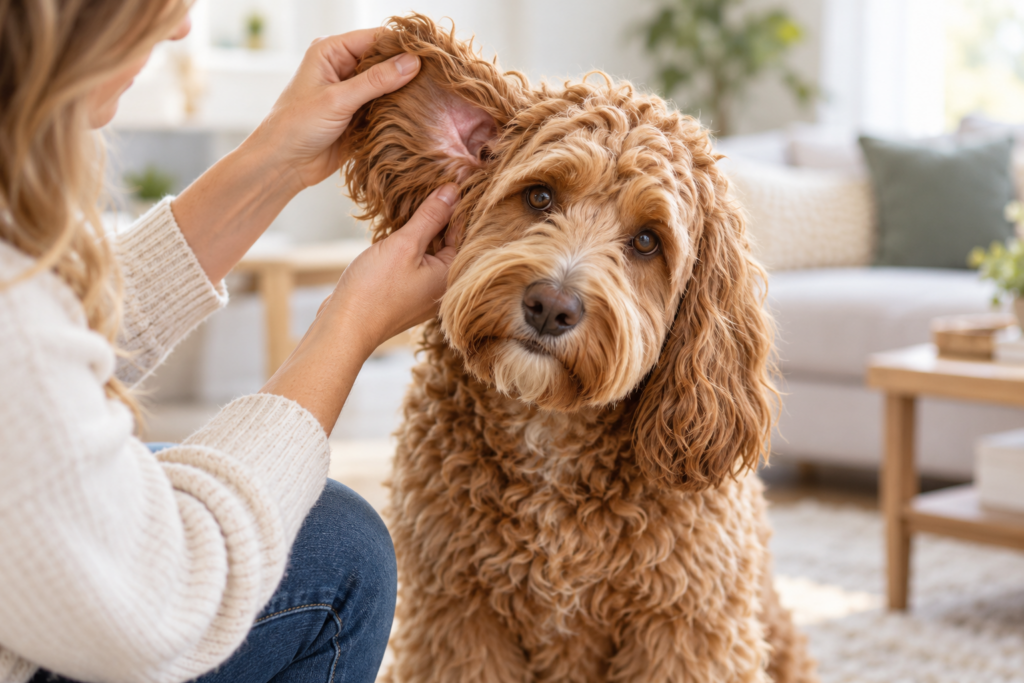
If you have a Labradoodle who gets one ear infection after another, you probably already know the routine.
They start shaking their head. Maybe there is a smell. The inside of the ear looks red or feels hot. You go to the vet, come home with drops and within a week or two everything looks considerably better.
Then, three weeks or three months later, you are back where you started.
At some point someone suggests chicken. Or beef. Or grass. Or yeast in the diet. Before long you have changed foods four times, ordered an allergy test from the internet, bought something promising to “detox” your dog and begun regarding your lawn with suspicion.
Meanwhile, the dog still has sore ears.
After more than four decades of living with dogs and more than twenty years breeding Australian Labradoodles, I think recurrent ear problems are one of those subjects where people desperately want one answer and very often there simply isn’t one.
That does not mean there is nothing you can do. In fact, there is quite a lot.
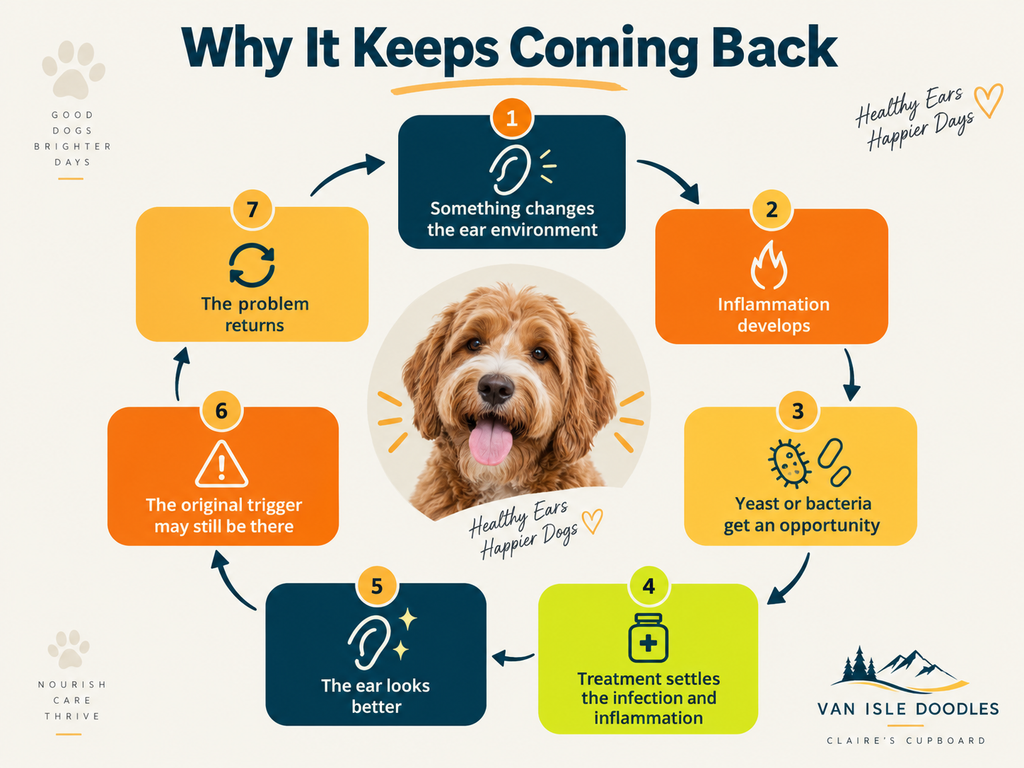
An ear infection is often the result of something else going on in the ear rather than the original problem itself.
Something changes the environment inside the ear canal. The ear becomes inflamed, warm, damp or otherwise less able to maintain its normal balance. Yeast or bacteria that may already live there quite happily begin multiplying and suddenly we have what everybody recognises as an ear infection.
Treat the yeast or bacteria and the infection improves.
But if whatever made that ear vulnerable is still there, the whole cycle can begin again.
That “whatever” might involve anatomy, moisture, environmental allergy, food, skin-barrier function, immune regulation, medication, underlying disease, over-cleaning or several things working together.
This is why I think it is important to stop thinking of yeast as the cause in every case.
Dogs normally have organisms including Malassezia yeast living on their skin. Finding yeast in an inflamed ear does not automatically tell us why the ear became inflamed.
The yeast may simply be taking advantage of an environment that has already changed.
That distinction matters.
If we decide “yeast is the problem”, we immediately start hunting for ways to starve, kill or detox yeast throughout the dog. We may completely miss the more useful question:
Why did this dog’s ear suddenly become such a lovely place for yeast to grow?
A large UK VetCompass study involving more than 22,000 dogs found that Labradoodles had almost three times the odds of being diagnosed with otitis externa compared with crossbred dogs.
The study looked at Labradoodles generally, not specifically multigenerational Australian Labradoodles, so I would not pretend it tells us precisely what happens in our breed population. But it does tell us this is not simply a collection of Labradoodle owners imagining things.
Ear shape matters too. Dogs with drop or pendulous ears had higher odds of otitis than dogs with erect ears. A floppy ear changes ventilation, warmth and moisture inside the canal.
Does that mean every Australian Labradoodle will have bad ears? Absolutely not. Most of mine do not.
Some dogs, however, are clearly more susceptible than others.
Possibly, although not in the simple sense that there is an “ear infection gene”.
Breed-related anatomy is inherited. So are aspects of skin, coat and immune function. Atopic disease also has a genetic component in dogs.
When I see recurring ear trouble appearing through particular family lines, I pay attention.
That does not mean a dog inherited an ear infection. They may have inherited a collection of characteristics that makes their ears more likely to become inflamed under the right circumstances.
Genetics loads the gun. Environment, health and circumstance may determine whether it fires.
Biology, of course, rarely has the courtesy to behave as neatly as we would like.
It might.
But recurrent ears do not automatically equal allergy and allergy does not automatically equal food.
Environmental atopy can certainly involve the ears. So can adverse food reactions. Some dogs with food allergy have recurrent otitis.
Others do not.
A dog may also be sensitive to something without having what we would technically call a true immune-mediated allergy. From the dog’s point of view, the distinction becomes rather academic when their ear hurts.
The useful question is whether we can identify a repeatable trigger and whether removing or managing it makes the dog better.
Food is irresistible as a suspect because it gives us something concrete to change.
Chicken goes out. Beef goes out. Then lamb. Then eggs. Eventually the poor dog is eating kangaroo and lentils while everyone waits for the ears to behave.
Sometimes food really is involved.
But changing proteins every time an ear becomes red does not diagnose a food allergy.
The recognised way to investigate a true adverse food reaction remains a properly controlled elimination diet followed by reintroduction or challenge. Blood, saliva and hair tests sold as shortcuts have repeatedly failed to diagnose canine food allergy reliably.
One particularly entertaining study even submitted synthetic fur and saline to a commercial hair and saliva allergy test. The test managed to find allergies in those too.
So if an internet report announces that your dog is sensitive to chicken, beef, turkey, carrots, dust mites, grass and possibly Thursdays, I would not reorganise their entire life around it.
Food can matter. An internet allergy panel is not how I would decide that it does.
When I suspect diet may be contributing to a yeast-prone or inflamed dog, my first move is usually not to permanently ban a common protein.
I simplify.
I will often go back to pure meat proteins and rotate the ordinary proteins I would normally feed, including chicken, turkey, beef, pork and lamb. I then add fruits and vegetables separately rather than relying on a complicated prepared formula containing many ingredients at once.
One vegetable blend I have used for this purpose is 3P Naturals Yeast Buster Blend, which contains green leaf lettuce, bok choy, kale and parsley.
The name should not be misunderstood. I am not suggesting a vegetable mixture travels to the ear and exterminates yeast.
What this approach does for me is simplify the diet, change the plant and nutrient profile and remove a lot of variables while I watch what happens.
I want to know whether the whole dog settles down.
If they do, I can begin adding things back deliberately rather than randomly banning proteins for life.
That is a very different exercise from deciding chicken caused the infection.
The ears make me more suspicious of a wider skin problem when they are not acting alone.
A dog who is also licking their paws, rubbing their face, scratching their belly or developing recurring skin irritation presents a different picture from a dog whose ears flare every August after swimming.
Patterns matter. So does timing.
I am also interested in whether the dog’s immune regulation, skin barrier and general health are functioning as well as they normally do.
A dog may tolerate an environmental trigger perfectly well for years and then begin reacting when other things change. That does not necessarily mean the trigger suddenly became more dangerous. The dog may simply have become less resilient to it.
Illness, prolonged stress, antibiotic use, hormonal disease, poor nutrition and other physiological challenges can all alter what is happening elsewhere in the body.
I also look at the medical timeline.
Has the dog recently been ill? Taken antibiotics? Had surgery? Been under unusual stress? Has there been a change in food, supplements, vaccination or parasite prevention?
None of those things automatically caused the ear problem. They are information.
I am conservative about unnecessary medical intervention generally. I prefer vaccinations based on need and current evidence rather than automatically giving everything because another twelve months have passed. I also make individual decisions about parasite prevention according to the dog, lifestyle and actual exposure risk.
If a previously stable dog suddenly changes, I want to know what else changed at roughly the same time.
Correlation is not proof. It is still worth noticing.
This is another reason I dislike reducing every food discussion to chicken versus beef.
Food is more than the name of its protein.
I care about the overall nutritional quality of what a dog eats, how the nutrients are supplied, the quality and stability of the fats, adequate essential fatty acids, vitamins, minerals and trace nutrients and how well that particular dog actually thrives on the food.
Skin is an organ. Maintaining a healthy skin barrier requires nutrition.
My preference remains a well-formulated fresh or minimally processed diet because that is the model I have had the best experience with over many years. That is my feeding philosophy, not proof that raw food cures ear infections.
Changing from chicken to lamb while leaving everything else unchanged may accomplish absolutely nothing.
Sometimes improving the overall diet is far more useful than endlessly changing proteins.
Understanding recurrent otitis is interesting. Living with it is another matter entirely.
My approach is not a veterinary protocol and I am certainly not suggesting ignoring a veterinarian when an ear is painful or seriously infected. It is simply how decades of living with dogs have taught me to approach the problem.
My mental checklist is fairly simple:
☐ Is there actually an infection now?
☐ Is it yeast, bacteria or both?
☐ Is the ear painful, swollen or unusual enough that it should be examined before anything goes into it?
☐ What has successfully treated this particular dog before?
☐ Are the paws, face or skin also itchy?
☐ Is there a seasonal, swimming or grooming pattern?
☐ Has anything changed in diet, medication, health or stress?
☐ Am I changing one thing at a time so I can actually learn from the result?
☐ Once the infection is gone, what can I do to reduce the chance of the next one?
That last question is where recurrent-ear management really begins.
If an ear is painful, very inflamed, producing significant discharge, swollen or repeatedly becoming infected, I want to know what we are dealing with.
Ear cytology can be extremely useful because yeast, cocci and rod-shaped bacteria are not interchangeable.
If an ear keeps failing to respond to the same treatment, I particularly do not want to keep blindly repeating it.
A severely painful ear, head tilt, balance problem, neurological sign or significant swelling needs veterinary attention. An ear where the condition of the eardrum is unknown also deserves caution before products are introduced.
This is not the time for kitchen chemistry.
Surolan is commonly prescribed in Canada and combines an antifungal, antibiotic and corticosteroid.
It can work very well and I have used it.
I have also had dogs where Zymox worked better, particularly in frustrating recurrent cases.
That is personal experience, not a claim that Zymox is superior for every dog or every infection.
Zymox uses an enzymatic system aimed at bacteria and yeast and there is some published research supporting its use in chronic canine otitis.
It is worth knowing that Zymox Otic and Zymox Ear Cleanser are not the same product. The Otic product is used as a treatment. The cleanser is for cleaning and maintenance.
If using Zymox Otic, the manufacturer specifically advises against cleaning the ear immediately beforehand because other topical products can interfere with the enzyme system.
Zymox can be frustratingly difficult and expensive to obtain in Canada, but I still think it is worth knowing about.
Burow’s Solution is another option I think deserves far more attention than it usually gets.
It is an aluminum acetate preparation with astringent and drying properties and can be remarkably effective.
A clinical study involving 142 dogs compared a modified Burow’s preparation with Surolan. The Burow’s treatment was considered non-inferior, with a 65 per cent cure rate after ten days compared with 59 per cent for Surolan.
That gets my attention because it also agrees with what I have seen practically.
Neither Zymox nor Burow’s should be treated as an invitation to put something into a severely painful ear without knowing what is happening inside it. The condition of the canal and eardrum matters.
But both belong in the conversation.
Once we start discussing cleaners, drying agents and treatments, there is a temptation to conclude that prevention means constantly doing something to the ears.
I take almost the opposite approach.
A dog with recurrent ear trouble may genuinely benefit from an individual maintenance routine.
The dog beside them whose ears are pale, clean, comfortable and odour-free may need absolutely nothing.
I do not routinely clean healthy ears simply because they belong to a floppy-eared dog.
Over-cleaning can irritate the ear canal and turn prevention into part of the problem.
A dog who swims constantly, produces excessive wax or has a history of recurrent trouble may need something different. Some benefit from appropriate cleaning or drying after swimming. Some need scheduled maintenance.
Others are considerably happier when everybody stops putting things into their perfectly healthy ears.
Leave well enough alone is a surprisingly useful principle in dog care.
If the problem keeps recurring, a simple record can be more useful than another supplement.
Write down when the flare happened, which ear was affected, whether the paws or skin were itchy too, whether the dog had been swimming or groomed, what season it was and whether anything had recently changed in food, medication, health or stress.
You are looking for patterns, not prosecuting suspects. One event proves very little. Three or four similar events may tell you something.
This is where desperate dog owners become excellent customers.
Collagen for allergies. Mushrooms for immunity. Probiotics for yeast. Colostrum. Detox powders. Homeopathic drops. Hair analysis. Saliva testing. Another supplement advertised by somebody standing beside a Golden Retriever in a field.
Some products may contain useful ingredients. Some may even help some dogs.
That is not the same as knowing why your dog’s ears keep becoming inflamed.
If you change five things at once and the ear improves, you have learned almost nothing.
If it does not improve, you have an expensive cupboard.
Sometimes we don’t.
You can investigate carefully, look at food, environment, seasons, anatomy, skin health and health history and still never identify one satisfying answer.
That is frustrating. It is not failure. At that point I change the goal.
Instead of “find the one thing causing this”, the goal becomes “make this happen as rarely as possible and deal with it quickly when it does”.
That may mean recognising the first subtle change in smell before the dog is miserable.
It may mean knowing which treatment works best for that individual dog.
It may mean managing swimming or seasonal triggers, simplifying the diet for a while or improving overall nutrition.
And it may mean accepting that this dog simply has vulnerable ears.
There are plenty of tendencies in dogs that we manage successfully without ever identifying one villain.
The same applies to sensitivity.
If something repeatedly makes a particular dog red, itchy or uncomfortable and removing it reliably stops the problem, that observation matters even if we cannot give it an impressive diagnostic label.
The discomfort is still real. The dog is still shaking their head. The veterinary bills still arrive.
We do not need to win an argument over terminology before we are allowed to make the dog more comfortable.
Australian Labradoodles do appear to be more susceptible to ear problems than many dogs.
That does not mean every recurrent ear infection is genetic. It does not mean chicken is responsible. It does not mean your dog needs an internet allergy panel.
And it certainly does not mean you need to eliminate every possible trigger until the dog is living in a climate-controlled bubble eating ostrich.
Repeated ear infections tell us that something is allowing the ear to become inflamed and lose its normal balance.
Yeast and bacteria are often what happens next, not the explanation for why the cycle began.
Sometimes we can identify the underlying problem.
Sometimes we cannot.
Either way, we can usually do considerably better than repeatedly treating the infection, waiting for it to return and starting all over again.
Look at the whole dog. Look for patterns. Treat what is actually happening in the ear. Support good nutrition, skin health and general health. Avoid unnecessary interference with healthy ears and find the smallest, simplest management plan that keeps that particular dog comfortable.
Because ultimately that is the goal. Not proving what caused the ear infection. Giving the dog fewer of them.
O’Neill DG et al. Frequency and predisposing factors for canine otitis externa in the UK: a primary veterinary care epidemiological view. Canine Medicine and Genetics, 2021.
Bernstein JA et al. Hair and saliva analysis fails to accurately identify atopic dogs or differentiate real and fake samples. Veterinary Dermatology, 2019.
Coyner K, Schick A. Hair and saliva test fails to identify allergies in dogs. Journal of Small Animal Practice, 2019.
Sadeghi S et al. Use of a modified Burow’s solution to treat canine otitis externa: a randomised comparative clinical study. Veterinary Record, 2022.
Effects of an enzyme agent containing mutanase and dextranase for treatment of biofilms in bacteria- and yeast-infected canine otitis externa. Polish Journal of Veterinary Sciences, 2022.
This article reflects my experience and approach after more than four decades of living with and breeding dogs. It is intended to help owners understand recurrent ear problems and ask better questions. Painful, severe, persistent or unusual ear disease requires veterinary assessment.
You will receive an email asking you to confirm your subscription. Be sure to check your spam folder. If you haven’t received a confirmation email after 24 hrs. please reach out via our Contact form.