
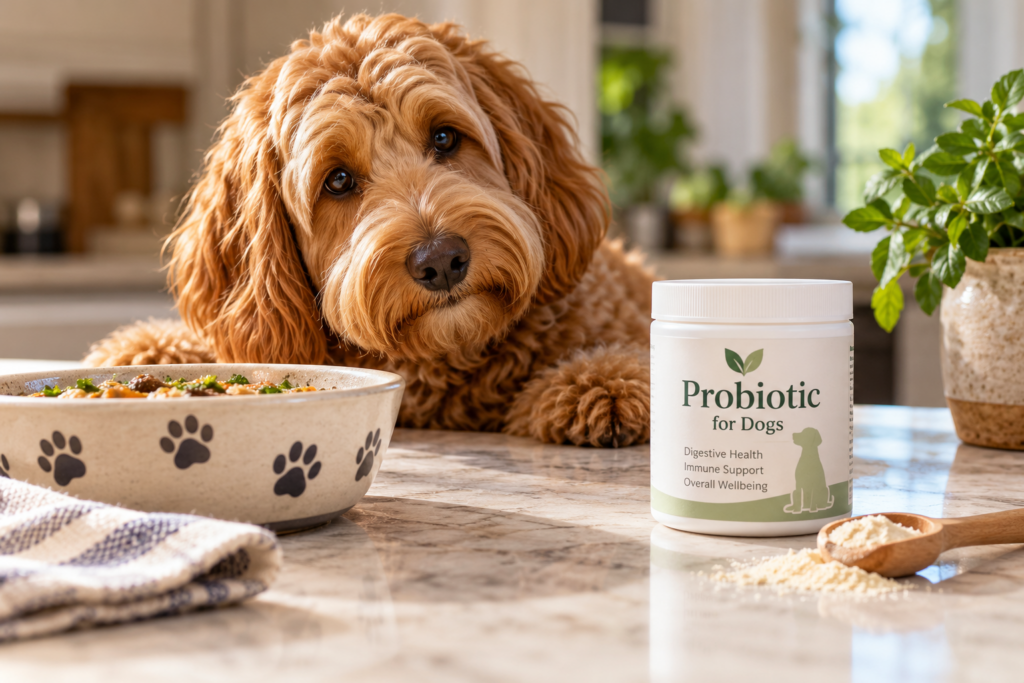
Does your dog need a probiotic? We compare Olie, FortiFlora, Proviable, Visbiome and more including strains, CFUs, puppies and antibiotics
Does your dog clear the room with one terrible fart? Does their breath make you reconsider the wisdom of face kisses? Do their stomach gurgles wake you in the night? Or does their coat sometimes resemble the “before” picture in a Head & Shoulders commercial?
If you have ever stood in a pet store holding a tub that promises to support digestion, immunity, skin, coat, breath and possibly world peace, you are not alone. Dog probiotics are credited with fixing an astonishing number of things.
Could the right one help with some of those problems? Possibly, depending on what is causing them and what is actually in the product. But a probiotic is not a substitute for a dental cleaning, a skin diagnosis or investigating ongoing digestive trouble. Before we buy the jar, we need to know what problem we are trying to solve.
This particular trip into Claire’s Cupboard began with Olie New Beginnings. I have recommended it for years and used it with my own dogs. Then I asked myself a slightly awkward question: can I honestly see any difference when they take it?
The answer is no. I can’t.
That does not prove it is doing nothing. When I take a probiotic myself, I notice a substantial difference in how I feel, but my dogs are unable to provide quite such a helpful review. Research has found measurable changes in the microbiomes of healthy dogs given synbiotics, even when there was no dramatic outward improvement for their families to see. Something may be happening beneath the surface, but a measurable change is not automatically a meaningful health benefit either.
And down the rabbit hole I went.
Ask “Which probiotic is best?” and you will get product names. Ask “What am I trying to accomplish?” and the answer becomes much more useful.
A healthy dog whose family wants a little general gut support is not the same as a puppy with diarrhoea. A dog taking antibiotics is not the same as a dog with chronic gastrointestinal disease. Yet we tend to sweep all of them into one very large probiotic bucket.
Twenty-five years ago, most dog owners were not discussing bacterial strains, fermentable fibres, microbial diversity or the canine gut microbiome. The research has come a long way, but it remains comparatively young and is changing quickly. Something I recommended in the past was not necessarily a poor choice because I might choose differently today. We work with what we know, then we keep learning.
You will see the word enteropathy in probiotic research. It simply means disease or dysfunction of the intestines. Chronic enteropathy refers to ongoing or recurring gastrointestinal problems such as diarrhoea, vomiting, appetite changes or weight loss.
Why should you care about that rather dull little word? Because a product studied in dogs with chronic enteropathy has not necessarily been shown to help a healthy dog who ate something revolting on the beach and has a soft stool for a day. The dog and the problem matter.
Here is the quick cupboard dictionary. A probiotic supplies live microorganisms. A prebiotic feeds selected microorganisms already living in the gut. A synbiotic combines the two.
Then there is Saccharomyces boulardii, usually shortened to S.boulardii. It is a beneficial yeast used much like a probiotic. Because it is a yeast rather than a bacterium, antibiotics do not affect it in the same way they affect bacterial probiotics. That gives it a particularly interesting role when antibiotics are being used.
Now we come to strain, which may be the most important word on the label. If a product lists Lactobacillus acidophilus, it tells us the species. If it lists Lactobacillus acidophilus LA-5®, it identifies the strain. Saying only “Lactobacillus acidophilus” is a bit like saying “an Australian Labradoodle”. It tells you something, certainly, but not which individual you are dealing with.
Probiotic effects can be strain-specific. A study showing that one strain helped dogs with diarrhoea does not prove that every strain of the same bacterial species will do the same thing.
And then there are the billions. CFU stands for colony-forming unit and estimates the number of viable microorganisms in the product. Fifty billion sounds far more impressive than 100 million, which is exactly why those numbers are splashed across labels. But the largest number does not automatically win. A smaller amount of a clearly identified and well-studied strain may tell us much more than an enormous bacterial crowd wearing no name tags.
This is the simple framework I now use before reaching into the cupboard:
| Situation | What I’m looking for |
|---|---|
| Healthy dog, general support | An optional routine probiotic or good dietary prebiotic support |
| Antibiotics | S. boulardii may be useful; bacterial probiotics need appropriate timing |
| Occasional digestive upset | Short-term gastrointestinal support, not automatically another lifelong supplement |
| Chronic gastrointestinal disease | Veterinary involvement and evidence for the actual condition being treated |
| Puppies | An age-appropriate product given for a reason |
| Pregnant or lactating dogs | A product-by-product assessment because several carry cautions |
| Healthy dog doing beautifully | Possibly nothing at all |
That final row is worth remembering. A healthy dog with excellent digestion does not necessarily have a probiotic-shaped hole waiting to be filled.
With that in mind, let’s turn around some of the jars and bags many dog families are actually using.
Olie is the long-time resident in my own cupboard. New Beginnings is a fermented liquid containing three clearly identified strains in the current Canadian product information:
I like that transparency because many dog products do not identify their organisms this precisely. What we do not have is strong clinical research showing exactly what these strains accomplish when New Beginnings is given routinely to healthy dogs.
I am not throwing my Olie down the sink. If a dog tolerates it well and the family feels it contributes to the dog doing well, there is no reason for panic at the cupboard door. I am simply less certain that every healthy dog needs it every day.
North Hound Life Probiotic+ has an intriguing origin story. Its organisms are reportedly sourced from healthy Canadian dogs and wolves, and it contains Jerusalem artichoke inulin as a prebiotic.
The organisms are identified by species, but their individual strain numbers are not publicly provided. That missing information matters because we cannot borrow research from another strain of the same species and assume it proves what this product will do. I see NHL Probiotic+ as a routine support product rather than one chosen to treat a particular condition.
Big Country Raw Thrive Pro-Gut is less a simple probiotic and more the whole digestive toolbox in one container. Along with probiotic organisms, it contains FOS, digestive enzymes, slippery elm, marshmallow, kelp, spirulina and other ingredients.
The current label is also quite clear: it is not for long-term use or for immature, pregnant, lactating or immunosuppressed animals. This is not the product I would casually sprinkle onto a puppy’s dinner because “probiotics are good”. It belongs in the shorter-term digestive support category for an appropriate adult dog.
Four Leaf Rover separates its formulas by purpose, which makes more sense than asking one product to be all things to all intestines.
Protect combines S. boulardii, Bacillus organisms, herbs, chlorella, blueberry, humic substances and bentonite clay. It may suit some dogs, but it is much more than “some good bacteria”. I would want a reason for choosing the entire formula.
Bifido For Fido is a large probiotic and prebiotic blend intended for occasional digestive upset rather than everyday long-term use. That distinction is useful. A temporary tummy problem and routine microbiome support are not necessarily the same job.
The product that interests me most here is S. boulardii. It is not affected by antibacterial medication in the same way as bacterial probiotics, and canine research supports its use alongside standard treatment in some dogs with chronic enteropathy. That does not mean every dog taking antibiotics needs it, but it has a more specific reason for being in the cupboard than “more bacteria must be better”.
WellyTails Digestive Enzymes & Probiotics Advanced is another whole-toolbox formula. It contains multiple probiotics, prebiotics, digestive enzymes and several other nutritional ingredients.
There is nothing wrong with that when broad digestive support is what the dog needs. The catch is that if the dog improves, we cannot easily know what helped. One ingredient? Several working together? The alignment of the planets? I would classify it as broad digestive support rather than simply a probiotic.
FortiFlora was one of the surprises of my research. Veterinary clinics recommend it frequently, yet the current Canadian formula contains just one strain, Enterococcus faecium SF68®, at 100 million CFU per serving.
Beside a tub shouting “50 BILLION”, that can look rather underdressed. Except SF68 has actually been studied in dogs. Not every study has found a benefit and FortiFlora is not the answer to every loose stool, but we know which strain we are giving and have canine research involving that same strain. Suddenly 100 million does not look quite so lonely.
Proviable contains seven individually identified probiotic strains plus prebiotics, making it a synbiotic. Its regular product is intended for ongoing digestive support, while the Proviable kit adds kaolin and pectin for short-term digestive upset.
Different tools for different circumstances. I like that. It starts with the problem rather than the assumption that every dog needs the same impressive-looking scoop of powder.
Visbiome lives on a rather different shelf. It is a very high-potency veterinary probiotic containing eight identified strains. The De Simone formulation used in Visbiome has been studied in dogs with chronic inflammatory enteropathy and is discussed in the 2026 ACVIM consensus recommendations.
That does not make it the grand champion of probiotics. It makes it particularly interesting for the condition in which it has actually been studied. This is where I think probiotic use needs to go: match the strain and the evidence to the dog and the problem.
Puppies are not simply small adult dogs with better hair. There is encouraging probiotic research involving specifically identified strains in very young dogs, but those findings apply to those strains, in those puppies and under those particular circumstances. They do not prove that every product with a puppy on the label is useful.
Some products provide puppy dosing. BCR Pro-Gut specifically says not to use it in immature animals, and several products have limited safety information for pregnant or lactating dogs. “It is only a probiotic” is not enough reason to assume that it suits every age and stage.
The useful questions are not “Are probiotics good?” or “Does my puppy need the most strains?” They are: does this puppy need one, what am I hoping it will do and is this particular product appropriate?
I did not emerge from this research clutching one victorious probiotic. I am not throwing out Olie, replacing everything with FortiFlora or deciding that veterinary products are automatically better than natural ones.
What changed is the way I choose. For a healthy dog whose family wants routine support, Olie or another well-tolerated product may be perfectly reasonable. During antibiotics, S. boulardii may have a specific role. For a brief digestive upset, a short-term gastrointestinal product may make more sense than signing the dog up for another supplement for life.
If a dog has chronic intestinal disease, I want the veterinarian involved and I am much more interested in research involving the actual strain and condition being treated. And sometimes, when a healthy dog is eating well, producing lovely stools and not conducting a stomach symphony at 3 a.m., the right answer may be nothing at all.
Now have a look in your own cupboard. What probiotic are you giving, what made you start it and can you tell whether it has made a difference? I would genuinely like to know.
For readers who would like to look more closely at the research behind this article:
Product formulations, directions and manufacturer cautions were checked against current product information available in August 2026.
You will receive an email asking you to confirm your subscription. Be sure to check your spam folder. If you haven’t received a confirmation email after 24 hrs. please reach out via our Contact form.