

Ripple turned nine this year and, if you asked her, I’m quite sure she would tell you that absolutely nothing has changed. She still runs, swims, chases her ball and expects the household to arrange itself around her comfort.
But nine did change something for me. Instead of simply booking her usual annual examination, I booked what our veterinarian calls a geriatric exam and blood panel.
Different clinics use different terminology. Some call it a senior wellness panel, some a senior blood panel and ours refers to it as a geriatric panel. The name really doesn’t matter. The important part is that once dogs move into their senior years, we want more information than we did when they were three or four. We want to know what normal looks like while they are still well, so that if something starts to change later, we have something meaningful to compare it with.
I suspect a lot of people don’t know that. We talk a great deal about puppy veterinary visits, vaccines and spay or neuter, but much less about the point at the other end of life when annual care should start looking a little different.

There isn’t one birthday that magically turns every dog into a senior. Size, breed, genetics and overall health all play a part. A large dog may enter the senior stage earlier than a small one.
In Ripple’s case, at nine, our veterinarian now considers her a geriatric patient for screening purposes. That doesn’t mean she is frail or elderly in the way we often use the word with people. It means we start paying attention differently.
And that really is the point of this stage. Not panic. Not suddenly treating a perfectly active dog as though she should be wrapped in cotton wool. Just paying closer attention to things that can change gradually enough that we may not notice them day to day.
Ripple’s bloodwork was excellent overall. Her organs looked healthy and nothing jumped out as a concern. Her alkaline phosphatase was a little low and her thyroid was sitting right at the bottom end of normal. Her veterinarian felt those results were most likely simply normal for Ripple, so we will recheck her thyroid next year and see whether anything has changed.
That is exactly why I like doing this testing while a dog is well. We now have a baseline for Ripple. If her thyroid numbers change next year or two years from now, we won’t be guessing about where she started.
It is also very reassuring to look at a nine-year-old dog you have raised from birth and see that, internally as well as externally, she is doing beautifully.
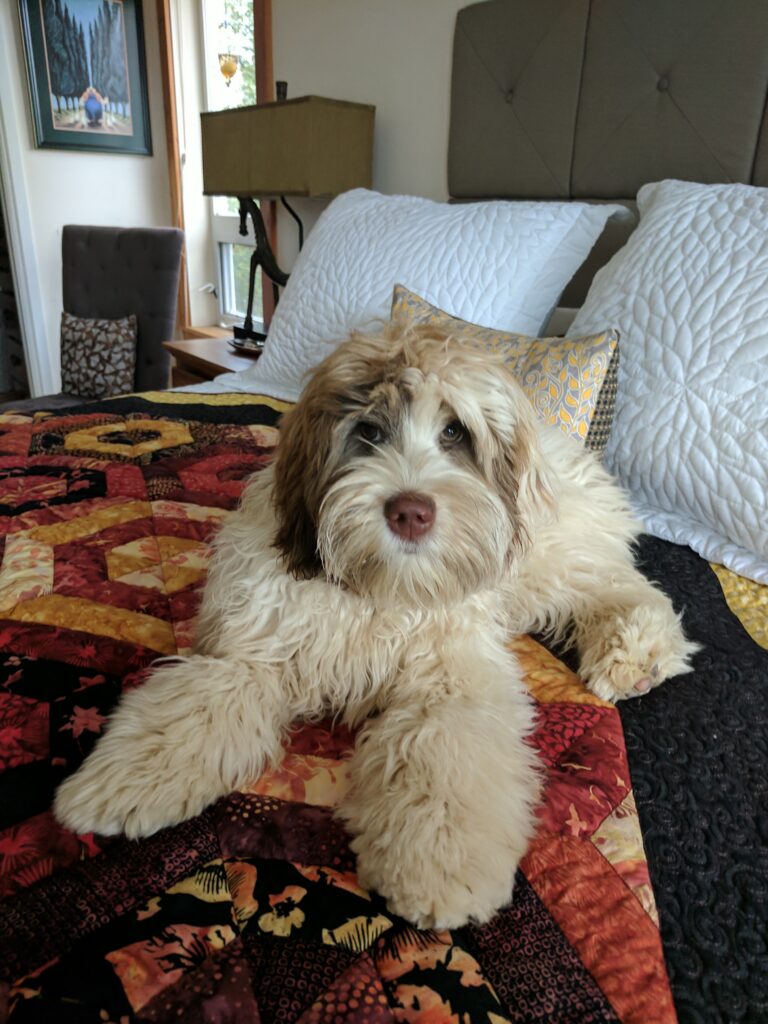
Ripple has eaten a properly balanced raw diet since birth. At nine, she still has a beautiful coat, excellent energy, good eyesight and hearing and a very strong desire to be involved in everything going on around her.
I attribute a good deal of that to the foundation she has had throughout her life. Good health is never one thing. Genetics matter. Exercise matters. Environment matters. Luck certainly has a hand in it too. But long-term, consistent, proper nutrition matters enormously as well.
This is something I have watched over many years and many dogs. You cannot feed poorly for eight years, add a handful of supplements at nine and expect them to undo the previous eight. Supplements can certainly have a place, but they are not a substitute for the foundation.
Ripple’s foundation has been very good.
One of the more useful parts of a senior examination is learning what we don’t need to worry about.
Ripple has some tartar on her teeth. Her veterinarian examined her mouth and considers it cosmetic. There is no infection, no gum disease and no discomfort, so in Ripple’s case there is no medical reason to put her under anaesthesia simply to make her teeth white. If that changes, obviously our decision changes.
Her veterinarian also suggested that I can remove some of the tartar myself with a hand scaler if I want to. That is advice specifically for Ripple after her mouth was examined. It isn’t a blanket recommendation for every dog with tartar.
The same applies to the small bumps she has developed on her skin. Her vet isn’t concerned about them, so we watch them. If one changes, becomes irritated or appears somewhere that makes it likely to cause problems, we deal with it.
There is a tendency, especially as dogs get older, to assume every new thing needs treatment. Sometimes the better decision is simply to know what you are looking at and monitor it.
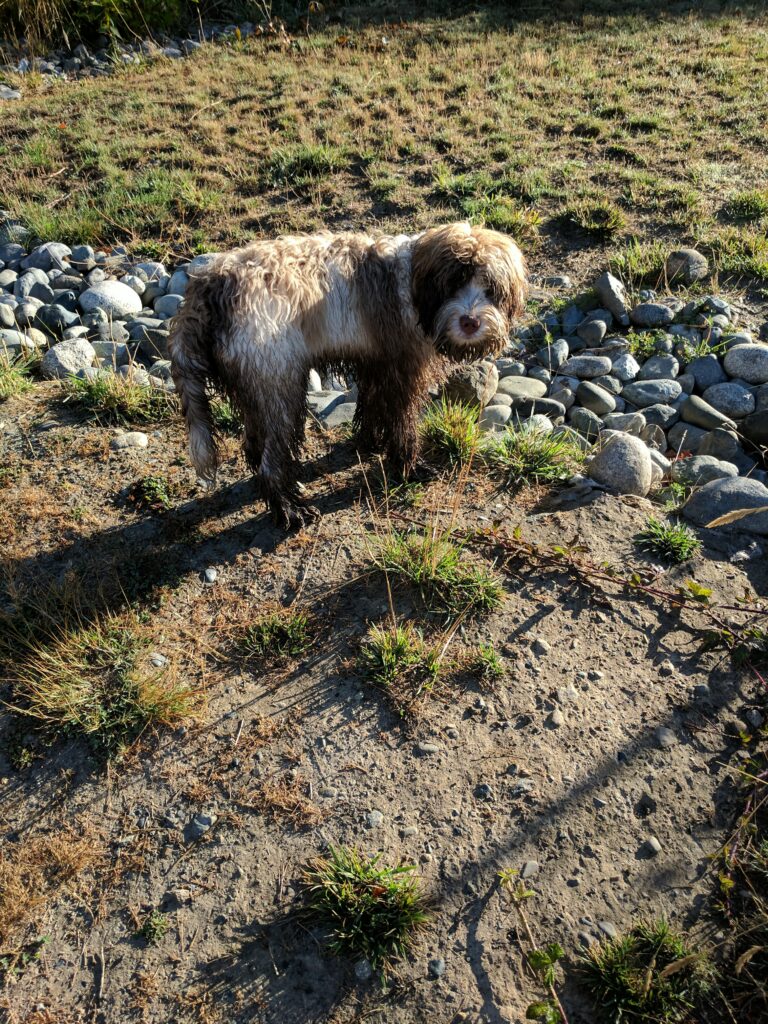
Ripple still runs, swims and chases her ball, although every now and then she gets a sore shoulder. I don’t believe the answer to ageing is to stop a dog from doing the things she loves. We adjust instead.
If Ripple is mildly sore, she gets an easier day. If it lasts longer than a day or affects how she is moving, we follow the plan we have discussed with her veterinarian and use Metacam as prescribed. Then she returns to normal activity gradually.
Maintaining muscle becomes increasingly important as dogs age. So does giving them reasons to continue using their bodies. Ripple would be thoroughly unimpressed if I announced that nine meant retirement from swimming and ball chasing.
Ripple’s parasite prevention has always been based on her actual exposure risk and discussions with our veterinarian rather than simply giving something because another month has appeared on the calendar. What is appropriate for Ripple, living where we do and with the lifestyle she has, may be quite different for another dog somewhere else.
Vaccination is approached the same way. Ripple had her core puppy vaccines and we now use titre testing to check her immunity. Her most recent titres continue to show strong protection.
Rabies is another discussion that depends very much on where you live, your local risks, travel and legal requirements. In Ripple’s case, our veterinarian and I have made decisions based on her particular circumstances.
I think that is one of the most important changes as dogs age. We stop doing things simply because we have always done them and start asking whether they still make sense for this particular dog.
Ripple’s weight was the clearest change.
She came in at 30.2 pounds and her ideal weight is closer to 25 or 26. She hadn’t suddenly become lazy. Her activity hadn’t changed, her routine hadn’t changed and neither had the amount of food she was eating. Her metabolism had.
She had been eating four ounces twice a day, so I reduced that slightly to 3.75 ounces per meal. Nothing dramatic. Just a small adjustment and then we watch.
Weight is one of the things I pay very close attention to as dogs get older. Carrying unnecessary weight makes everything harder, particularly joints and mobility, and it is something we can actually control.
I don’t look at Ripple and see an old dog. I see Ripple. She is still funny, active, affectionate, demanding and very much involved in life. What has changed is not how I see her, but how closely I watch the little things.
Her annual veterinary visit now gives us more information. We know what her bloodwork looks like while she is healthy, we know what her veterinarian wants us to monitor, we have made a small adjustment to her food and we continue to keep her active.
That, to me, is what good senior care looks like. It isn’t about trying to make them young again. It is about understanding what is changing, catching problems early and making thoughtful decisions that keep them comfortable, strong and interested in life for as long as possible.
You will receive an email asking you to confirm your subscription. Be sure to check your spam folder. If you haven’t received a confirmation email after 24 hrs. please reach out via our Contact form.