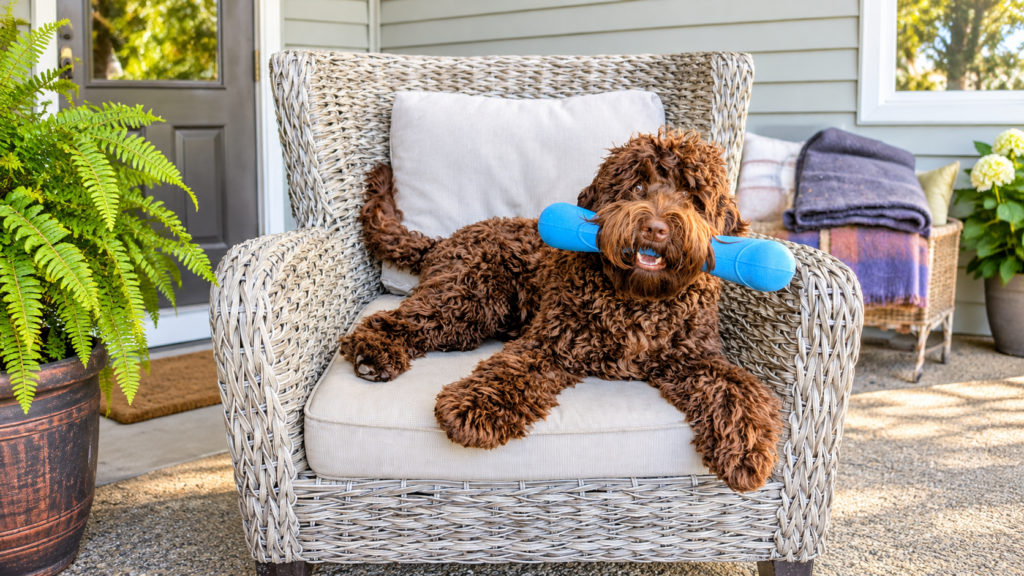
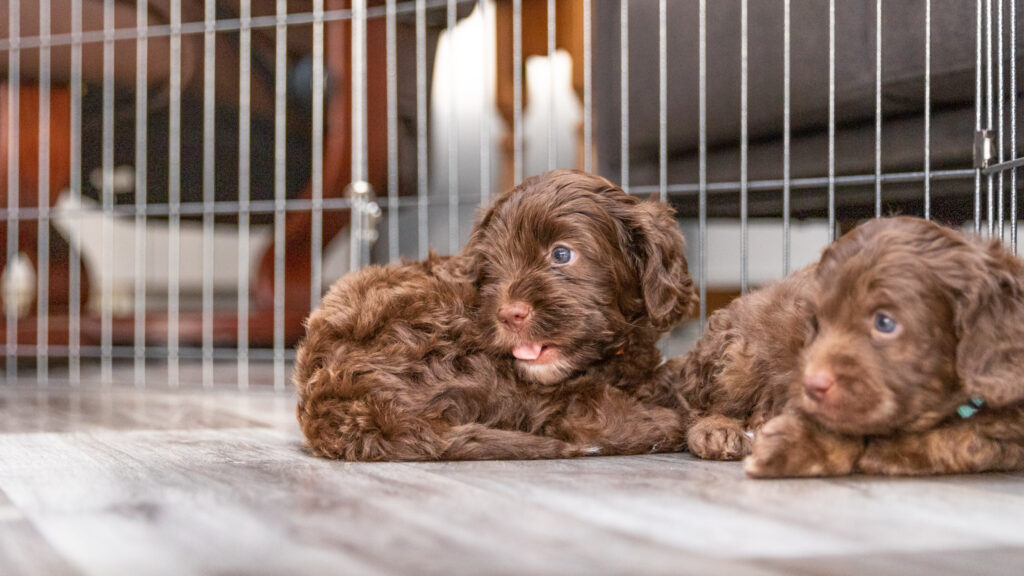
Australian Labradoodles are routinely described as intelligent, easy to train and wonderfully calm family dogs.
This morning Beau, our eight-month-old Australian Labradoodle, dismantled a battery-operated tea light.
In his defence, he is temporarily on restricted activity after hurting himself, which has left a perfectly good young Australian Labradoodle brain with considerably less to do than it considers appropriate. Beau has therefore taken responsibility for his own enrichment programme. Recent projects have included a pumpkin, a quarter-pound of butter and the aforementioned tea light.
So yes, they are intelligent.
That does not necessarily mean easy.
And calm? We need to talk about that too.
After more than twenty years with Australian Labradoodles, I think their temperament is far more interesting than the usual collection of adjectives. They are enormously people-oriented, socially clever, emotionally responsive, playful and very quick to learn. Many are soft without being timid, exuberant as youngsters yet capable of developing a lovely adult off-switch.
They also watch us rather closely.
They learn our routines, read our responses and quickly discover whether the household rules are actually rules or merely suggestions still under discussion.
There is quite a lot going on under the goofy.
| You may hear… | What it really means |
|---|---|
| “They are very intelligent.” | They learn quickly, including things you never intended to teach them. |
| “They are easy to train.” | They are quick to learn, but clever dogs also notice inconsistency and can become excellent trainers of humans. |
| “They are calm.” | Puppies are busy. Many ALDs develop an excellent adult off-switch with maturity, appropriate activity and good guidance. |
| “They are very social.” | People tend to matter enormously to them. That connection is wonderful, but independence also needs to be taught. |
| “They are sensitive.” | Many are soft and highly responsive to tone, emotion and human feedback rather than timid or fragile. |
| “They are family dogs.” | They generally want to participate in family life, not simply live alongside it. |
| “They all have wonderful temperaments.” | Purposeful breeding gives us greater predictability, but every puppy remains an individual whose temperament develops through experience. |
That last line is important.
A breed can have recognisable temperament traits without every puppy being a carbon copy of the next.
Australian Labradoodles generally learn very quickly.
They learn that sitting nicely earns a treat. They also learn which family member is most likely to produce one without the sitting.
They know where the food lives, what time dinner normally happens and whether barking once at the back door makes a human appear.
That is intelligence too.
The phrase “easy to train” can therefore be misleading. A quick-learning dog can acquire desirable behaviour remarkably fast, but they can become equally efficient at learning things you never intended to teach.
Because Australian Labradoodles are highly interested in people, our reactions matter enormously.
This becomes especially inconvenient when they are funny.
It is remarkably difficult to deliver a convincing message about unacceptable behaviour while laughing at the perpetrator.
They notice.
Beau certainly does.
Living successfully with a clever dog means giving that brain somewhere productive to go. Physical exercise matters, but so do sniffing, exploring, problem-solving, learning and simply being involved in everyday life.
A fifteen-minute walk followed by an otherwise empty day is unlikely to satisfy many young Australian Labradoodles.
Leave that brain unemployed and it may become self-employed.
You may not approve of its chosen profession.

Almost every family asks me for a calm puppy, which is unfortunate because healthy puppies aren’t particularly calm.
They race, wrestle, climb, chew and investigate things that no reasonable adult would consider worthy of investigation. Then they collapse in a heap and sleep as though somebody switched them off.
What families are usually describing is the adult dog they hope that puppy will become.
They want a dog who enjoys activity but can settle afterwards. One who fits comfortably into the normal rhythm of family life without requiring a full-time entertainment committee.
That is a perfectly reasonable goal.
But I cannot identify that adult simply by looking for the quietest puppy at five weeks.
A quiet puppy may be thoughtful. They may also be uncertain.
The puppy bouncing happily through the middle of everything may eventually become beautifully steady once maturity and impulse control arrive.
What interests me far more is what the puppy does with the world.
If something surprises them, what happens next? Do they recover and investigate?
When something desirable is unavailable, can they tolerate the frustration and think their way through it?
Can they move from high excitement back to a thinking state?
This is why words such as bold, quiet, shy and calm can be surprisingly unhelpful when used alone. They describe what a puppy did in one moment.
They don’t necessarily tell us why.
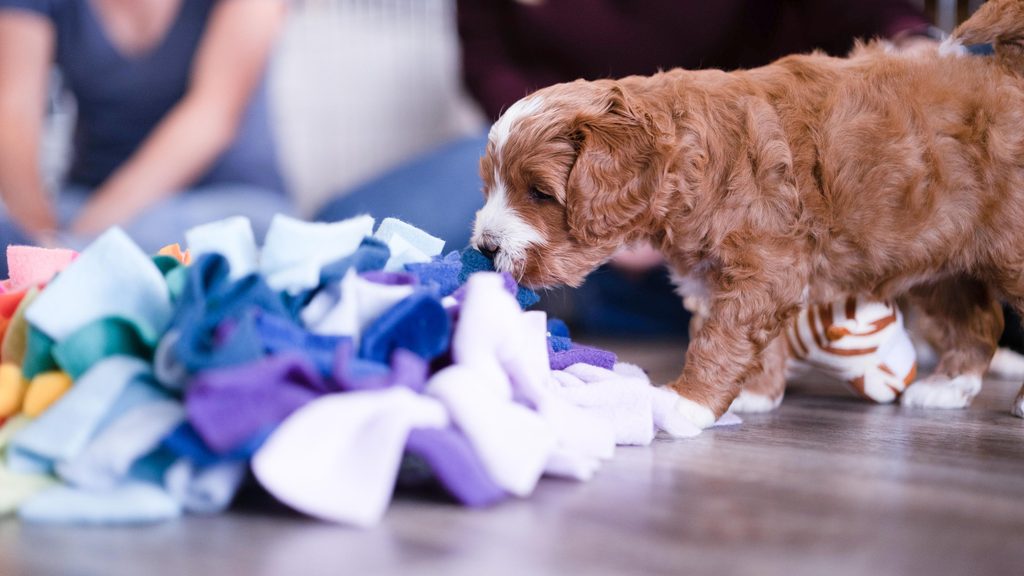
We see a wonderful example of this after almost every Family Visit Day.
At around five weeks, our families spend an afternoon with the litter. For a young puppy it is a significant experience: unfamiliar people, different voices and smells, plenty of handling and a frankly unreasonable amount of admiration.
Then we watch what happens.
The puppy who had previously been a little thoughtful may have just spent several hours discovering that complete strangers consider them magnificent.
People, apparently, are excellent.
Over the following days that puppy may become noticeably more socially confident.
Meanwhile, the puppy who had previously been first into absolutely everything may decide that twenty enthusiastic humans were rather more intense than anticipated. The next time something unfamiliar happens, that puppy may pause and take a little more time.
Neither puppy has suddenly acquired a different genetic temperament.
They have had an experience and incorporated it.
Video: Decoding 4-week-old puppy personalities
That is one of the most important things to understand about Australian Labradoodle temperament.
Genetics matters enormously, particularly in a breed developed through generations of purposeful selection. But predictability does not mean uniformity.
GALA describes the Australian Labradoodle as a purpose-bred companion developed with careful attention to temperament, health and balanced structure, with the goal of producing well-rounded, predictable companion dogs.
That is exactly the distinction.
Predictable does not mean identical.
We looked more closely at that question in What the Doodle Studies Actually Tell Us, including why research that groups every sort of “doodle” together tells us relatively little about a carefully selected multigenerational Australian Labradoodle population.
Temperament develops through a continuing conversation between inheritance, maturation, environment, learning and experience.
We can watch that conversation happening while the puppies are still here.

That is why our puppy programme has never been a socialisation checklist.
Vacuum cleaner, done.
Different surface, done.
Car ride, done.
Stranger, done.
Congratulations. Puppy successfully socialised.
Real puppies are considerably less tidy.
The thoughtful puppy may need carefully graded opportunities to investigate something new and discover that they can handle it. Each success gives them useful information for the next experience.
The puppy who assumes the entire world is a personal invitation needs something different. Their lesson may be to pause, tolerate frustration or discover that launching themselves head first into absolutely everything isn’t mandatory.
One puppy needs encouragement.
Another needs less stimulation.
Another needs the opportunity to solve something without a human immediately rushing in to help.
We are not trying to manufacture identical puppies. We are watching what each puppy brings to the table and providing experiences that expand rather than suppress their natural temperament.
Socialisation is not about turning a thoughtful dog into a bold one or an exuberant dog into a quiet one.
It is about helping both become capable.
That philosophy runs through our entire programme. Our Story explains more about why we raise puppies as individuals rather than treating every litter as a production line.
Research supports the importance of age-appropriate early social experiences, while also reminding us that puppy development is considerably more complicated than simply exposing a puppy to as many things as possible.
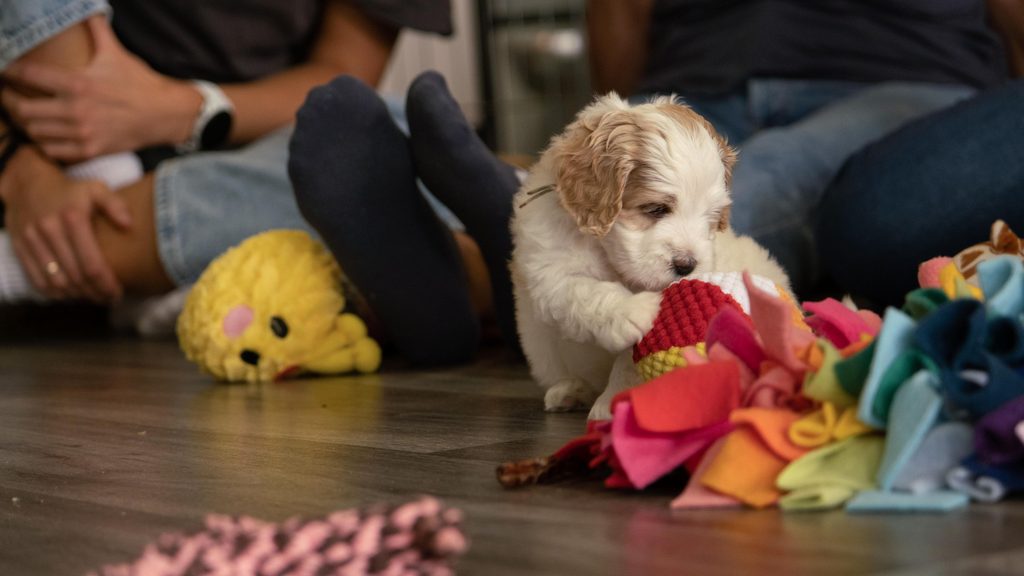
If I had to put one characteristic at the centre of Australian Labradoodle temperament, it would be their relationship with people.
Australian Labradoodles have been selectively developed from dogs who genuinely value human interaction. Our article What Is an Australian Labradoodle? looks more closely at how the breed developed and why purposeful multigenerational selection matters.
GALA puts it rather neatly too: these dogs were developed to connect naturally with people. They are not meant to live around us. They are meant to live with us.
You see the result every day.
These dogs watch faces, notice tone and learn household routines with sometimes alarming speed.
Many seem to know you are preparing to leave before you have consciously admitted it yourself.
A closed bathroom door may be regarded as a fairly serious breakdown in family communication.
Their intelligence combined with that social awareness can make them seem uncannily human at times.
Which is exactly when we need to remember that they are not.
They are dogs.
They need to sniff, explore, play, chew appropriate things, solve problems, tolerate frustration and develop independence.
Treating an Australian Labradoodle as a furry human baby can actually interfere with the confidence we are trying to build.
Deep connection and healthy independence are not opposites.
A dog can have both.
That lesson begins while our puppies are still with us.
Once they are developmentally ready, at around four weeks, we begin creating small, manageable experiences that help them discover that separation is safe. Their world gradually expands beyond constant contact with Mum, littermates and people and they begin practising the ability to settle independently.
Families continue that work after their puppy goes home.
A puppy can adore you and learn that you sometimes leave.
They can relax in another room, a crate, pen or comfortable resting space and discover through experience that nothing terrible happens.
Separation-related behaviour is complex and there is no single cause. Individual temperament, early experience, routine and environment can all play a part.
That is why I would never promise that one particular formula “prevents separation anxiety”.
What breeders and families can do is give puppies repeated, age-appropriate opportunities to develop the skill of independence.
A puppy who has always had immediate company cannot suddenly know how to cope with being alone simply because the humans now require it.
Independence is a skill.
Teach it before you need it.
Another characteristic I see repeatedly in Australian Labradoodles is softness.
I don’t mean weakness or nervousness.
I mean responsiveness.
Many notice changes in our voice, emotions and body language remarkably quickly. Approval matters and so does tension.
That social awareness is one reason positive reinforcement suits the breed so beautifully.
But positive does not mean permissive.
A clever, people-focused dog still benefits from clear and consistent communication.
If jumping on someone is unacceptable on Tuesday, hilarious on Wednesday and unacceptable again on Thursday, the dog has not failed to understand the rule.
The humans have failed to have one.
And Australian Labradoodles are remarkably good at discovering those inconsistencies because they spend so much time observing us.
The same social intelligence that makes them highly responsive to good training can make them exceptionally talented at training an inconsistent human.
All of this is also why I don’t think an Australian Labradoodle is the right breed for everyone.
These dogs generally want to be full members of family life.
They don’t need a “job” in the Border Collie sense. They need involvement.
Walks and learning matter, but so do gardening, car rides, visitors, sitting nearby while you work and generally being included in the ordinary fabric of the household.
They want to belong.
If what you want is a pleasant dog who is quite content to exist independently at the edges of family life, there are breeds better suited to that role.
Similarly, people who routinely work away from home for long days need a realistic plan, particularly during puppyhood. Appropriate daycare, a dog walker, family help or another arrangement can make that possible.
The issue isn’t that Australian Labradoodles cannot be alone.
They should learn to be.
There is simply an enormous difference between healthy independence and spending most of one’s life waiting for the family to return.

My education in psychology taught me early that behaviour without context doesn’t tell us very much.
Later, twenty-five years working in family and criminal law reinforced much the same lesson with people.
One moment can be interesting.
Patterns tell you far more.
More than four decades of breeding dogs has taught me the same thing again.
The puppy who hesitates today may charge forward tomorrow after one successful experience. The puppy who appears fearless may actually be impulsive. The puppy who climbs into every lap during Family Visit may simply love everyone rather than having somehow selected a future family.
So we watch when they are excited and tired, frustrated, surprised and successful. We watch them with Mum, littermates, people and sometimes by themselves.
Most importantly, we watch what changes.
That is why I have never placed much faith in deciding who a puppy is from a single temperament test administered on one particular day.
Temperament is not a photograph.
It is a moving picture.
Understanding that moving picture is what eventually allows us to decide which puppy is most likely to thrive with which family.
That is another subject in itself, and one we explore in How We Match Puppies to Families.
A well-bred Australian Labradoodle is typically a deeply connected, socially intelligent family dog who pays close attention to people and learns with remarkable speed.
They tend to be playful and exuberant as puppies, with enough curiosity and brains to keep their humans occupied, but many develop a wonderful ability to settle as they mature.
They are often emotionally soft rather than hard, responsive rather than insensitive and affectionate without needing to become helplessly dependent.
They are also not effortless.
Their intelligence needs engagement. Their social nature needs relationship. Their sensitivity needs thoughtful communication and their strong attachment to people makes teaching independence particularly important.
That is the bargain.
In return, you get a dog who doesn’t merely live in your house but tends to become woven into the life happening inside it.
They notice you.
They learn you.
They make you laugh.
And fairly regularly, they outsmart you.
The breeder begins with genetics and those first critical weeks of development. The family picks up where we leave off. Neither can manufacture temperament from nothing and neither works in isolation.
Do both parts well and that busy, ridiculous puppy has the opportunity to grow into what I think is the Australian Labradoodle at its best: intelligent without needing a constant job, deeply connected without being dependent, playful without being perpetually frantic and soft enough to listen when we communicate well.
Still goofy, of course.
We wouldn’t want to breed that part out.
Global Australian Labradoodle Association (GALA). Australian Labradoodle Breed Standards and The GALA Approach. The Australian Labradoodle is described as a purpose-bred companion, with temperament, emotional stability, health and structure central to responsible breed development.
Van Isle Labradoodles. What Is an Australian Labradoodle? Breed development, pedigree, purposeful selection and what separates an Australian Labradoodle from a generic Labrador–Poodle cross.
Van Isle Labradoodles. What the Doodle Studies Actually Tell Us. A closer look at research on “doodles”, variation and why breeding population matters when discussing temperament predictability.
Howell, T.J., King, T. & Bennett, P.C. (2015). Puppy parties and beyond: the role of early age socialization practices on adult dog behavior. Veterinary Medicine: Research and Reports, 6, 143–153.
McEvoy, V., Baqueiro Espinosa, U., Crump, A. & Arnott, G. (2022). Canine Socialisation: A Narrative Systematic Review. Animals, 12(21), 2895.
Sargisson, R.J. (2014). Canine separation anxiety: strategies for treatment and management. Veterinary Medicine: Research and Reports, 5, 143–151.