
More Than Meets the Eye
Of course I stopped scrolling.
A traditional tri-coloured Bernedoodle with two brilliant blue eyes is difficult not to notice. She was beautiful, unusual and exactly the sort of dog social media was designed to make us stop and look at.
But it was the explanation beneath the photograph that held my attention.
The post explained that the dog carried a blue-eye variant associated with ALX4. It had originally been introduced through Australian Shepherd lines, but generations of breeding had diluted the Australian Shepherd ancestry while retaining the desired blue-eye variant.
I read that part twice.
How can the Australian Shepherd be completely removed when the deliberately retained piece of Australian Shepherd DNA is precisely what is being celebrated?
That question sent me down a rabbit hole involving blue eyes, merle, Australian Shepherds, Bernedoodles, commercial breed testing and an impressive-sounding word I had rarely encountered before.
It also brought me back to a question families occasionally ask me:
Do you produce Australian Labradoodles with blue eyes?
The short answer is no.
The more interesting answer is why.
Not Every Breeder Is for Every Family
Before we go any further, this is not about criticizing a beautiful dog or the breeder who produced her.
Breeders make different choices about the qualities they want to preserve and develop. Some programmes deliberately pursue rare colours, markings or other distinctive physical traits. There are families who are particularly drawn to those qualities.
Our approach is different.
Not every breeder is the right breeder for every family, just as not every puppy is the right puppy for every home. What matters is that breeding goals are transparent and that families understand what the language and test results being presented to them actually mean.
Different breeding priorities are a matter of choice. Genetic claims are still questions of evidence.
Blue Eyes Are Not One Thing
Blue eyes in dogs can arise through several genetic pathways. Looking at the dog does not necessarily tell us which pathway is responsible.
| Genetic pathway | What the research tells us | What it does not tell us |
|---|---|---|
| Merle, associated with PMEL | Merle alters pigment distribution and can produce blue eyes, marbling or heterochromia. Dogs inheriting two merle variants face a substantially greater risk of auditory and ophthalmic abnormalities.[5][6] | Blue eyes alone do not tell us that a dog is merle. They also do not tell us whether a dog has one or two merle variants. |
| White spotting and reduced pigmentation | Reduced pigment extending across the eye area can sometimes result in a blue eye. White spotting genetics involve MITF and several interacting variants.[4] | There is not one simple “Irish spotting blue-eye gene.” Current white spotting tests do not explain every visible pattern or every blue eye. |
| Duplication near ALX4 | A 98.6-kilobase duplication upstream of ALX4 is strongly associated with blue eyes and heterochromia, particularly in Siberian Huskies. It has also been found in a small number of Australian Shepherds.[3] | The study did not establish that every carrier will have blue eyes or that the variant predicts health, temperament or sensory processing. |
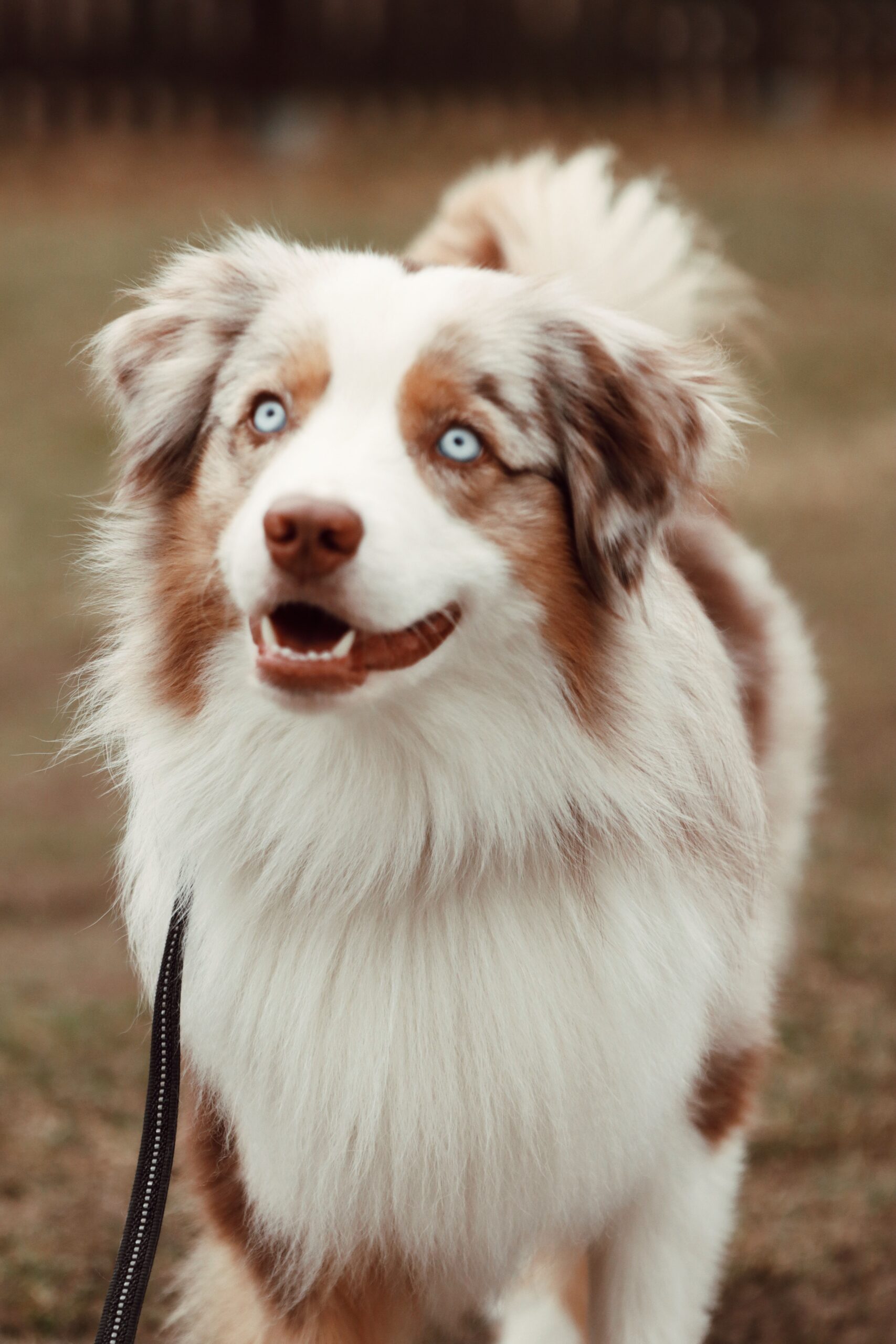
The Australian Shepherd pictured with this article is merle. Its blue eyes could be associated with merle, the ALX4-associated duplication or an interaction involving more than one pigmentation pathway. We cannot determine that from a photograph.
That is our first important point:
An appearance is an observation. It is not a genetic diagnosis.
What the ALX4 Research Found
The ALX4 research is genuinely interesting.
A study involving more than 6,000 dogs identified a duplication located upstream of the ALX4 gene that was strongly associated with blue eyes. Most of the dogs carrying it were Siberian Huskies. In the study’s validation group, researchers also found it in two Klee Kai, five Australian Shepherds and one Australian Cattle Dog.[3]
The high proportion of blue-eyed dogs carrying one copy suggested a dominant effect. However, the researchers also found 46 brown-eyed dogs carrying one copy of the associated haplotype.
In other words, dominant does not mean guaranteed.
Other genetic factors may modify or mask its expression. That makes “predictable” a relative term, particularly when a variant is moved into a different breed mix where it has not been studied across generations.
It is also slightly misleading to refer to the “ALX4 gene” as though it were a special gene present only in blue-eyed dogs. Dogs have the ALX4 gene. What researchers identified was a particular duplication upstream of it that appears to affect its regulation.
Most importantly, the study investigated eye colour. It did not study anxiety, aggression, auditory processing, light sensitivity or temperament. It provides no evidence that this particular blue-eye pathway causes behavioural problems, but it also was not designed to provide a comprehensive health guarantee.
A test result should be allowed to answer the question it was designed to answer. It should not be asked to answer five others.
When Authority Sounds Scientific
As I followed the blue-eye trail, I found an article written by someone identifying themselves as a “cynologist.”
That sounds impressively official. Merriam-Webster defines a cynologist as someone specializing in the care and training of dogs.[2] It is a descriptive term, however, not proof of a particular education, regulated qualification or body of research.
I could call myself a cynologist. After more than four decades of breeding, raising, observing and studying dogs, the description would certainly fit. The word alone would still not make everything I say correct.
The article proposed a connection between blue eyes and anxiety, reactivity, aggression and sensory-processing difficulties. Much of the reasoning came from observations of two blue-eyed dogs receiving behavioural training.[1]
Those observations may be completely genuine. They may even provide the beginning of an interesting research question. What they cannot do is establish that the dogs’ eye colour caused their behaviour.
Two dogs with blue eyes and behavioural difficulties demonstrate that two blue-eyed dogs had behavioural difficulties.
They do not demonstrate that blue eyes caused those difficulties.
The references did not resolve that problem. For example, one paper cited in support of altered visual processing actually studied how dogs responded to life-sized dog replicas with different tail lengths.[7] It did not investigate blue eyes, merle-related vision or visual-processing deficits.
This is something readers should always watch for. A reference can be a perfectly valid scientific paper without providing evidence for the claim beside which it appears.
Scientific terminology is not the same as scientific evidence. A title is not evidence either.
Can Australian Shepherd Ancestry Be Bred Out?
This brings us back to the Bernedoodle.
When a dog with Australian Shepherd ancestry is repeatedly bred back to Bernedoodles, the overall proportion of Australian Shepherd ancestry can become smaller with each generation. Eventually, it may fall below the level a commercial ancestry algorithm reports.
At the same time, the breeder can test each generation and deliberately select the dogs that retained the desired blue-eye variant.
The general Australian Shepherd contribution becomes increasingly diluted while that particular piece of inherited DNA remains because someone is actively selecting for it.
That is entirely possible.
What is not precise is saying the Australian Shepherd has been completely bred out. It has been reduced. It may no longer be detected or reported by a particular test. It remains part of the dog’s genealogical history and the retained variant is evidence of that history.
The Australian Shepherd may disappear from the breed report. It does not disappear from the history of the trait.
An Ancestry Estimate Is Not a Pedigree
Commercial breed tests compare a dog’s DNA with reference populations and use an algorithm to estimate which breeds the tested segments most closely resemble.
That can produce useful information. It is not the same as reading an accurately maintained pedigree.
Breed inference becomes more difficult when dogs have ancestry from numerous breeds, when breeds are closely related, when a breed is poorly represented in the reference panel or when the contribution from a particular ancestor has become very small. Recent canine ancestry research acknowledges that the size and composition of reference populations affect what can be identified and how accurately admixture can be estimated.[8][9]
A result showing no Australian Shepherd therefore means that the test did not assign a reportable portion of the dog’s DNA to its Australian Shepherd reference population. It does not prove that an Australian Shepherd never appeared in the pedigree.
This distinction matters:
- A trait test asks whether a tested variant was detected.
- An ancestry estimate asks which reference populations portions of the DNA most closely resemble.
- A parentage test asks whether particular dogs could be the biological parents.
- A pedigree records known genealogical relationships.
- A breeding decision considers the entire dog, its relatives and the proposed pairing.
These are related sources of information. They are not interchangeable.
As I explained in Dog DNA Testing: What the Results Really Mean, a DNA panel can be an extremely valuable tool. It is not a breeding programme.
What Was the Bernedoodle Meant to Accomplish?
One of the common reasons given for crossing Bernese Mountain Dogs with Poodles is the hope of improving health and longevity while retaining some of the Bernese Mountain Dog’s appealing qualities.
That is an understandable goal.
Bernese Mountain Dogs carry a documented health burden. A Swiss study of 389 Bernese Mountain Dogs reported a median lifespan of 8.4 years. Neoplasia was listed as the cause of death in 58.3 per cent of the dogs, although the researchers cautioned that many cancer diagnoses had not been confirmed through cytology or histopathology.[10]
We do not yet have strong Bernedoodle-specific longevity data that allow us to say exactly how the cross has changed those outcomes.
Crossing two breeds may reduce the likelihood of some recessive disorders when the parents do not carry the same harmful variants. It does not automatically remove dominant conditions, complex polygenic disease, structural problems or health risks already present within the family lines.
A 2024 study involving 9,402 dogs compared Labradoodles, Cockapoos and Cavapoos with their parent breeds. It did not include Bernedoodles, so we must not pretend it did. However, it offers a useful caution about assuming that crossing automatically produces better health. Across 342 comparisons, researchers found no statistically significant difference in 86.6 per cent of the health comparisons.[11]
Crossbreeding can create opportunities. It does not replace selection.
Against that background, describing a combination of eye-colour and coat genes as a major breeding breakthrough naturally raises a question:
A breakthrough towards what?
For a programme intentionally developing rare visual traits, the answer may be clear. For our programme, the definition is very different.
What a Breeding Breakthrough Means to Us
At Van Isle, a breeding advancement is not something that can be captured in a photograph or reduced to a string of colour-test results.
We are looking for dogs who contribute to:
- emotionally steady and socially connected temperaments
- sound structure and comfortable movement
- strong health testing supported by family history
- longevity across generations
- appropriate genetic diversity
- resilience, fertility and maternal ability
- consistency without sacrificing the individuality of each dog
DNA testing contributes important information. So do pedigrees, health records, mature structure, temperament, relatives and years of observing what a line actually produces.
A dog can have an impressive collection of desirable test results and still not be the right dog to breed. Another dog may not possess a rare or fashionable appearance but may offer exceptional qualities that improve an entire lineage.
A genetic profile can help explain how a dog looks. It cannot, by itself, tell us whether that dog should reproduce.
Why We Do Not Breed Blue-Eyed Australian Labradoodles
An Aussiedoodle has an Australian Shepherd parent or Australian Shepherd ancestry. An Australian Labradoodle does not.
The word “Australian” in Australian Labradoodle refers to where the breed was developed. It does not mean the breed contains Australian Shepherd.
If you want to discover the full story of how the breed developed, start with What Is an Australian Labradoodle?
The recognized Australian Labradoodle parent breeds are the Poodle, Labrador Retriever, Irish Water Spaniel, Curly Coated Retriever, American Cocker Spaniel and English Cocker Spaniel.[12] Australian Shepherd is not one of them.
Merle is also not an accepted Australian Labradoodle pattern. The Australian Labradoodle Association of America states that merle dogs receive limited registration and are not to be bred.[13]
We would not introduce Australian Shepherd ancestry, merle or another novel pigmentation variant simply to create blue eyes. Doing so would move us away from the breed we have spent generations developing and from the qualities our families come to us for.
That does not mean blue eyes are unattractive. They are undeniably striking. They caused me to stop scrolling, after all.
It means appearance alone is not enough reason to redirect a breeding programme.
At Van Isle, colour is an outcome, not an objective.
More Than Meets the Eye
The blue-eyed Bernedoodle did exactly what an unusual-looking dog is likely to do. She caught my eye.
The genetic explanation made me curious. The certainty of some of the language made me look more closely. The deeper I went, the more clearly the different pieces connected.
A formal-sounding designation does not establish expertise.
A citation does not necessarily support the claim beside it.
A trait result is not an ancestry report.
An ancestry estimate is not a pedigree.
A list of appearance genes is not a complete breeding evaluation.
None of this makes the puppy less beautiful. It does not make her breeder wrong for pursuing a different goal. It simply demonstrates why families should understand what a breeding programme values and decide whether those priorities align with their own.
Not every breeder is for every family.
The qualities we value most in a dog rarely stop anyone mid-scroll. Temperament, soundness, resilience, longevity and the ability to become deeply connected to a family are difficult to photograph.
They are still the qualities that matter long after the photograph has been forgotten.
Frequently Asked Questions
Why do some doodles have blue eyes?
Blue eyes in doodles can result from merle, reduced pigmentation associated with white spotting or a duplication near the ALX4 gene. The possible source depends on the breeds and genetic variants present in that particular dog’s ancestry.
Can a Bernedoodle have blue eyes without being merle?
Yes. A non-merle Bernedoodle could have blue eyes through an ALX4-associated variant introduced from another breed or through reduced pigmentation affecting the iris. A DNA test is needed to distinguish some of these possibilities, and even then current tests may not explain every case.
Do blue eyes prove that a Bernedoodle has Australian Shepherd ancestry?
Not by themselves. Blue eyes have more than one genetic cause. However, if an ALX4-associated variant was deliberately introduced through Australian Shepherd lines, then Australian Shepherd is part of the dog’s genealogical history even if a commercial ancestry test no longer reports it.
Are blue-eyed dogs more anxious or reactive?
There is no good evidence that blue eye colour itself causes anxiety, aggression or reactivity. Sensory impairment can influence behaviour in any dog, but the presence of blue eyes does not establish that a dog has impaired vision or hearing. Behaviour must be assessed through the individual dog, its family history, development and environment.
Are blue eyes in dogs unhealthy?
Blue eyes are not automatically unhealthy. The genetic pathway matters. Double-merle dogs face an increased risk of hearing and eye abnormalities, while the ALX4-associated blue-eye study did not establish a health problem caused by the duplication. Eye colour alone cannot determine a dog’s health.
Can a non-merle dog be bred safely to a merle dog?
A genetically confirmed non-merle dog bred to a single-merle dog should not produce double-merle puppies. That prevents one particular high-risk combination. It does not make the entire breeding “zero risk” because every pairing involves many other health, structural and genetic considerations.
Why doesn’t Van Isle breed blue-eyed Australian Labradoodles?
Australian Shepherd is not a recognized parent breed of the Australian Labradoodle and merle is not an accepted pattern. We do not introduce ancestry or select a novel variant solely to create a visual effect. Our breeding decisions begin with temperament, health, structure, longevity, family history and genetic diversity.
Can a dog DNA test replace a pedigree?
No. A commercial ancestry test estimates which reference populations a dog’s DNA most closely resembles. A pedigree records genealogical relationships. Breed testing can provide useful information, but failure to report a breed does not prove that the breed never appeared in the dog’s ancestry.
Explore more Australian Labradoodle articles in Discover ALDs
References
- De Gols, B. (2024). The Blue-Eyed Puzzle: Unravelling the Genetic and Behavioral Challenges of Tater Tot and Finnley. Canine Evolutions.
- Merriam-Webster. Cynologist. Merriam-Webster.com Dictionary. Accessed August 11, 2026.
- Deane-Coe, P. E., Chu, E. T., Slavney, A., Boyko, A. R. & Sams, A. J. (2018). Direct-to-consumer DNA testing of 6,000 dogs reveals 98.6-kb duplication associated with blue eyes and heterochromia in Siberian Huskies. PLOS Genetics, 14(10), e1007648.
- Baranowska Körberg, I., Sundström, E., Meadows, J. R. S. et al. (2014). A simple repeat polymorphism in the MITF-M promoter is a key regulator of white spotting in dogs. PLOS ONE, 9(8), e104363.
- Clark, L. A., Wahl, J. M., Rees, C. A. & Murphy, K. E. (2006). Retrotransposon insertion in SILV is responsible for merle patterning of the domestic dog. Proceedings of the National Academy of Sciences, 103(5), 1376–1381.
- Strain, G. M., Clark, L. A., Wahl, J. M., Turner, A. E. & Murphy, K. E. (2009). Prevalence of deafness in dogs heterozygous or homozygous for the merle allele. Journal of Veterinary Internal Medicine, 23(2), 282–286.
- Leaver, S. D. A. & Reimchen, T. E. (2008). Behavioural responses of Canis familiaris to different tail lengths of a remotely controlled life-size dog replica. Behaviour, 145(3), 377–390.
- Kislik, G., Moore, G., Rubbi, L., Supara, V. N., Chen, G. & Pellegrini, M. (2026). Inference of admixture in dogs from whole genome sequences. Gigabyte, 2026, gigabyte173.
- Sexton, C. L., Reichel, C., Keyser, A. et al. (2025). Comparing owner-reported and genetic breed identification reveals high concordance in a large cohort from the Dog Aging Project. Scientific Reports, 15, 30493.
- Klopfenstein, M., Howard, J., Rossetti, M. & Geissbühler, U. (2016). Life expectancy and causes of death in Bernese Mountain Dogs in Switzerland. BMC Veterinary Research, 12, 153.
- Bryson, G. T., O’Neill, D. G., Brand, C. L., Belshaw, Z. & Packer, R. M. A. (2024). The doodle dilemma: How the physical health of designer-crossbreed Cockapoo, Labradoodle and Cavapoo dogs compares to their purebred progenitor breeds. PLOS ONE, 19(8), e0306350.
- Australian Labradoodle Association. Australian Labradoodle Parent Breeds. Accessed August 11, 2026.
- Australian Labradoodle Association of America. Australian Labradoodle Coat Colours and Patterns. Accessed August 11, 2026.